
The origins of the library date back to 1769 when a well-deserved Santarcangiolo, Teodoro Felice Grazj, left his rich library to the Collegiate Church of Santarcangelo by testamentary arrangement. Since then there were many people and organizations that contributed to the birth of Baldini. Some funds – such as those of Grazj, Balducci, Giovenardi – have come into the possession of the Municipality of Santarcangelo following the suppressions of some entities; others instead through donations made by families, as happened for the fund Antonio Baldini, the Fondo Volpe and that of Luigi Renato Pedretti; others still through studies, collaborations and interventions – from Augusto Campana to Flavio Nicolini, from Tonino Guerra to Nino Pedretti and Lello Baldini.

In 1961, the then Mayor Filippo Tassinari appointed Flavio Nicolini to form a provisional committee to study the reorganization of the municipal library and the cultural activities involved. In 1964 the library, in a small room of the municipal headquarters, began to offer the first loan services to citizens. Over the years were given temporary assignments for its management from Giorgio Serafini to Giuseppe Pecci by Agostini Vignali to Guerrino Canini and finally to Gianni Fucci who remained in service until his retirement.

Only on 15 October 1974, with the appointment of Silvano Beretta as Director, the library had a worthy location in the building “ex Dispensa sali e tabacchi”, in via Cavallotti 3. At the retirement of Beretta the management was entrusted to Mario Turci assisted by Donata Mancini.

On 23 April 2014, the former director Pier Angelo Fontana inaugurated the “House of Culture” which houses the new municipal library named after the journalist and literary critic Antonio Baldini (Rome, 10 October 1889 – 6 November 1962).

The original project of the building – the work of the architect Benedetto Sancisi in collaboration with the engineer Nazareno Zavagli – dates back to 1863. This new location, of about 1,800 square meters, has allowed a considerable expansion of the library, transforming the “Baldini” into a place for information, dissemination of culture and knowledge and at the same time in an area of aggregation and socialization open to the whole city.
In 1961, the then Mayor Filippo Tassinari appointed Flavio Nicolini to form a provisional committee to study the reorganization of the municipal library and the cultural activities involved. In 1964 the library, in a small room of the municipal headquarters, began to offer the first loan services to citizens. Over the years, temporary assignments for its management were given from Giorgio Serafini to Giuseppe Pecci, to Agostini Vignali (who, together with six trusted people, inventoried and cataloged the roughly 10,000 volumes and papers of the Baldini donation), to Guerrino Canini, and finally to Gianni Fucci, who remained in service until his retirement, working alongside the future director.

Only on 15 October 1974, with the appointment of Silvano Beretta as Director – mayor Romeo Donati – did the library find a worthy location in the building “ex Dispensa sali e tabacchi”, in via Cavallotti 3, where the historical archive (up to the 20th century) converged, along with the rich heritage of about 3,500 ancient books, the art gallery – later moved to the Musas – and the modern section accessible to the public. At Beretta’s retirement, management was entrusted to Mario Turci, assisted by Donata Mancini, specially appointed.

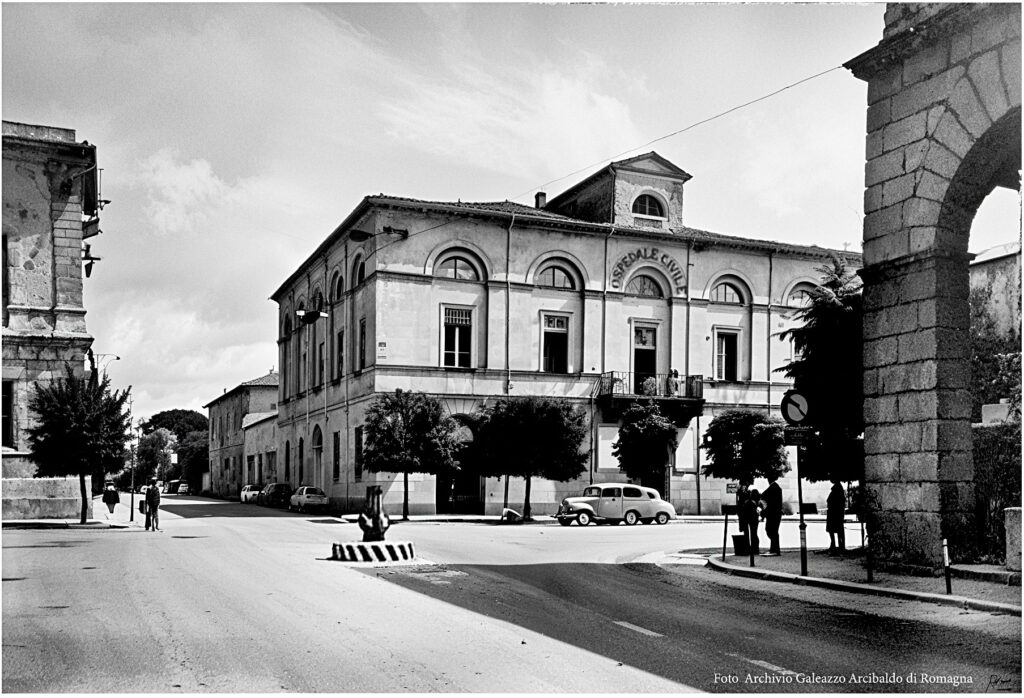
On 23 April 2014, then-director Pier Angelo Fontana, after a long restoration of the former Civil Hospital building of Santarcangelo, inaugurated the “House of Culture,” which houses the new municipal library named after journalist and literary critic Antonio Baldini (Rome, 10 October 1889 – 6 November 1962). The building is located at the beginning of Via Pascoli, in the historic “lower” part of the city where the Municipal Palace stands, along with the Arch named after the Santarcangelo-born Pope Clement XIV, at the corner with Piazza Ganganelli.

The original design of the building that currently houses the library – the work of architect Benedetto Sancisi in collaboration with engineer Nazareno Zavagli, commissioned by a charitable brotherhood presided over by Count Antonio Baldini – dates back to 1863. Construction lasted 7 years and the Hospital became operational in 1871. It occupied this historic site until 1998 when, following a fire, it was moved to a new building; the former Hospital building was then completely restored and repurposed to house the municipal library.
This new location, of about 1,800 sqm, allowed considerable expansion of the library, transforming the “Baldini” into a place of information, dissemination of culture and knowledge, and at the same time a space for gathering and socializing open to the whole city. A true “House of Culture” where activities promoting and disseminating literature coexist with, and reinforce, the conservation and enhancement of the archives and collections held.

Bibliography:

Giuseppe Rabotti, L’archivio storico del comune di Santarcangelo di Romagna, Sovrintendenza archivistica per l’Emilia Romagna; Rome, 1969.

Augusto Campana, La biblioteca Comunale di Santarcangelo, Rimini, Luisè Editore, 1986.

Silvano Beretta, La Biblioteca Civica, Santarcangelo di Romagna, Municipal Administration, 1986.

Silvano Beretta, Istituzioni culturali a Santarcangelo dal XVIII alla fine del XX secolo, Santarcangelo di Romagna, Stampato in proprio, 2015.

Pier Angelo Fontana, Giorgio Ioli, Francesco Soldati (eds.), Fra storia e memoria: l’Ospedale Civile di Santarcangelo (1871-1998): le sue vicende, la sua evoluzione, Cesena, Il Ponte Vecchio, 2019.